


Tracing the Process:
Sketches and Ideation.


Completing quick sketches, writing notes, and gathering photos are some of the most important parts of Fairbrother’s process. She often begins by writing about the work to first describe the idea in simple, direct language that helps clarify the form it might take. From this written foundation, she translates the idea into a quick sketch, deciding whether it needs to remain loose and gestural or become more refined based on the difficulty of the piece.
Overtime, she has learned to document her process more intentionally, capturing photos throughout the making of a piece. This act of tracing the process of a work reinforces her belief that the preliminary stages (the notes, the sketches, the experiments) hold as much importance as the final object/piece itself.


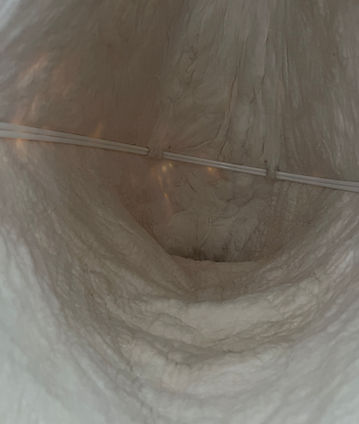


Regardless, you still remember the sensations of our childhood.
felted wool, found textile, stainless steel carabiner, stainless steel cable
15" x 65" x 30”
2024
This immersive cocoon-like womb is an individual, sensorial escape for recovery, growth, and discovery. It was designed for my childhood best friend, Chiara, using essential visual and olfactory elements to conjure shared childhood experiences. The structure provides a fitted, protective pocket that encourages vulnerability and healing while obstructing the motions of the outside world; something that alleviates, and allows her to remember the sensations of our childhood.
Exhibited at:
Bespoke, Anna and Norman Student and Alumni Gallery, Cleveland Institute of Art, Cleveland, OH
Fresh: Perspectives from the SculptureX Network, The Sculpture Center, Cleveland, OH


During the three months spent creating Regardless, you still remember the sensations of our childhood, Fairbrother approached the work with a deep emotional intention to make something to aid her best friend, Chiara. This piece was made in response to the research and writing of artist, Sarah Hendren for the exhibition, Bespoke at the Cleveland Institute of Art.
Writing through the concept helped her articulate the cocoon as both a physical structure and an intimate vessel shaped by shared childhood sensations and the need for safety. As the form developed through sketches, material tests, and structural experiments, she remained focused on how Chiara’s body would inhabit the piece, ensuring it offered comfort, protection, and space for quiet restoration. Documenting each stage of the process made visible the gradual shaping of the felted wool and textiles into a womb-like enclosure, that would then be installed with steel hardware for security.
2024


Untitled (The Separation of Bodies)
acrylic, spray foam, and yarn on canvas
Together: 48" x 93"
2024
I am drawn to the inevitable, abject changes and transformations associated with inhabiting a body: the decaying, the healing, the dying, and the unraveling. My work explores surfaces, often taking on organic forms, combining reactive and intentional mark-making to create textures that sag, drip, wrinkle, and fold, emulating bodily properties. Globs of elastic, fleshy paint slather onto the surface while other thin drips suggest fluidity. Deep tones of red, brown, purple, black, and peach soil the work. Fascinated by how fabrics and textiles can be manipulated, I meticulously dissect these tangible materials. I intensely rip, stain, pull, adhere, and sew to create sculptural paintings that are unavoidable, acknowledging their physicality and sensation. The process is responsive and repetitive, mimicking the strenuous acts of destruction and mending.I lean into tactility, forcing the viewer to face the raw, bodily essence of these marred paintings. I want the viewer to feel the work, to experience it with their body, as if it is pressing against their skin.


While developing Untitled (The Separation of Bodies), Fairbrother approached the piece with a few preliminary writings and sketches, but she came to her material conclusions by making smaller experiments with the same techniques. She began by reflecting on the body’s constant states of decay and repair, using language to articulate how paint, spray foam, and thread might emulate flesh/bodily insides that sags, drips, or swells. Considering how the materials could respond to gravity, stitching and paint/medium application was also important.
The making process became a dialogue with the body itself by ripping, staining, pulling, and layering in ways that echoed cycles of destruction and mending. By documenting each stage, she traced the work’s transformation from a flat drawing into a sculptural painting that confronted its own physicality, especially through her final decision to connect the pieces, making them one.
2024


whiteout
laser etching embedded in found fabric, acrylic, lace, embroidery floss
20” x 20" x 2"
2025
Translation:
once i dreamed a memory, the thick coating of snow piles gently evading time in its stillness. the colors buzz and gleam with reflective light. i squint tightly and rub my eyes with the tips of my fingers. and the image of our back porch becomes engraved in the darkness of my eyelids. as my hands fall back to my sides the wind grazes my soft skin. it feels bleak and cold. i can remember only this far, since i always forget it all as it comes back to me.
2025


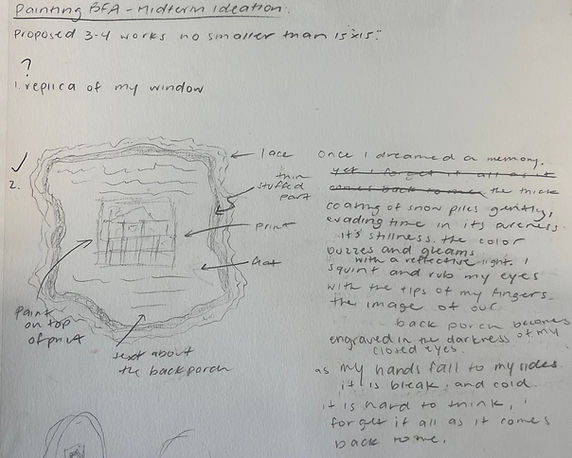
In creating whiteout, Fairbrother began by writing through the memory that anchors the piece, using broken-up, poetic language to capture the hazy, dreamlike sensation of a childhood snowfall and the way certain images imprint themselves in our minds only to disappear quickly after. These early notes helped her imagine how fabric, lace, and etched surfaces could convey a fragile interplay between clarity and forgetting. She translated her composition onto fabric, experimenting with how textiles absorb paint, hold embroidery, and respond to embedded prints.
Throughout the process, she documented each stage to trace how the work shifted. The act of stitching, staining, and layering became a way to physically negotiate the instability of memory, allowing the piece to embody both the softness of nostalgia and the sharpness of loss. This was one of Fairbrother’s first experiments working within the parameters of her BFA thesis concept of memory, and the home as archive.

BRIANNA FAIRBROTHER